A tidal wave from the Grand Line
Launched by Bandai in Japan in 2022 before arriving progressively in Europe, One Piece Card Game (OPCG) established itself within a few years as one of the most dynamic TCGs on the market. Carried by the massive popularity of Eiichiro Oda's license and by gameplay designed to be both accessible and deep, the game attracts long-standing manga fans and experienced players from other TCGs alike.
In France, OPCG grew explosively once the first French-language boosters arrived. Specialist stores quickly opened weekly tournaments, and the French competitive scene organized itself around the regional championships run by Bandai. For anyone looking to get into a young TCG, with a community still taking shape and a metagame that redefines itself with every set, One Piece Card Game is an ideal opportunity.
How does One Piece Card Game work?
The basics
Every game of OPCG pits two players against each other as pirate captains, the famous Leader. The Leader is the deck's central card: both your strategic identity and your win condition. To win, you have to reduce your opponent's Leader to zero by dealing damage beyond their remaining Life pool.
Each player builds a 50-card deck around their Leader, respecting the colors associated with it. OPCG has six colors: Red (aggressive), Green (board control), Blue (hand manipulation), Purple (resource acceleration), Black (reducing opponents' costs) and Yellow (synergies around Life). A two-color Leader allows the use of both corresponding colors.
The turn
An OPCG turn has five phases: Refresh, Draw, Don!!, Main and End. The central mechanic rests on Don!! cards, a universal resource used both to pay play costs and to boost characters during combat. Each player starts with a separate ten-card Don!! deck and activates them progressively over the turns, creating a very readable power curve.
Managing Don!! is what makes the game special: experienced players know that attaching too much Don!! to a character early can leave an exploitable gap, while holding too much back can mean defeat against a well-executed rush.
Game formats
Standard: the reference format
Standard is the format used in every official Bandai tournament. It allows all sets currently in rotation, with an official banlist updated regularly to balance the metagame.
It's in this format that competitive players face off at Regional Championships and Super Pre-Release events held in major cities.
Limited: testing your drafting skills
The Limited format is played by opening boosters at the table and building a deck from the cards you get. It's an excellent format for evenings with friends, or for discovering new sets as soon as they launch.
Homebrew formats
The OPCG community is already experimenting with alternative formats, notably Starter Deck Only (playing exclusively with standardized starter decks) and a Commander-like format with a mandatory unique Leader. These variants are perfect for casual store tournaments.
The archetypes worth knowing
The OPCG metagame moves fast, but some archetypes have established themselves as references:
| Archetype | Color | Play style |
|---|---|---|
| Red Luffy | Red | Aggressive rush, constant pressure |
| Red/Purple Kid | Red/Purple | Explosive mid-game combo |
| Blue Law | Blue | Hand control and tempo |
| Black Doflamingo | Black | Reducing opponents' costs |
| Yellow Big Mom | Yellow | Life manipulation and synergies |
Each archetype has its own visual and narrative identity, faithful to the manga's arcs. That's also part of the game's flavor: facing an opponent playing the crew that rivals yours has something inherently thematic about it.
Getting properly equipped
Cards and sleeves
One Piece cards are standard size (63 × 88 mm), the same as Magic: The Gathering or Pokémon. That means your usual sleeves work perfectly. As with any TCG, investing in quality sleeves is essential to preserve your cards: rare leaders and alternate arts can reach three-figure values on the secondary market.
For competitive players, always keep a spare set of sleeves in your bag: at a tournament, a judge can ask for a damaged sleeve to be replaced, and it's rare to find exactly the same model at the last minute.
The deck box: an increasingly strategic item
An OPCG deck consists of 50 main cards, to which you add your Leader and your 10-card Don!! deck, meaning 61 sleeved cards to carry. Some players also add tokens, counter dice or replacement cards for alternative formats.
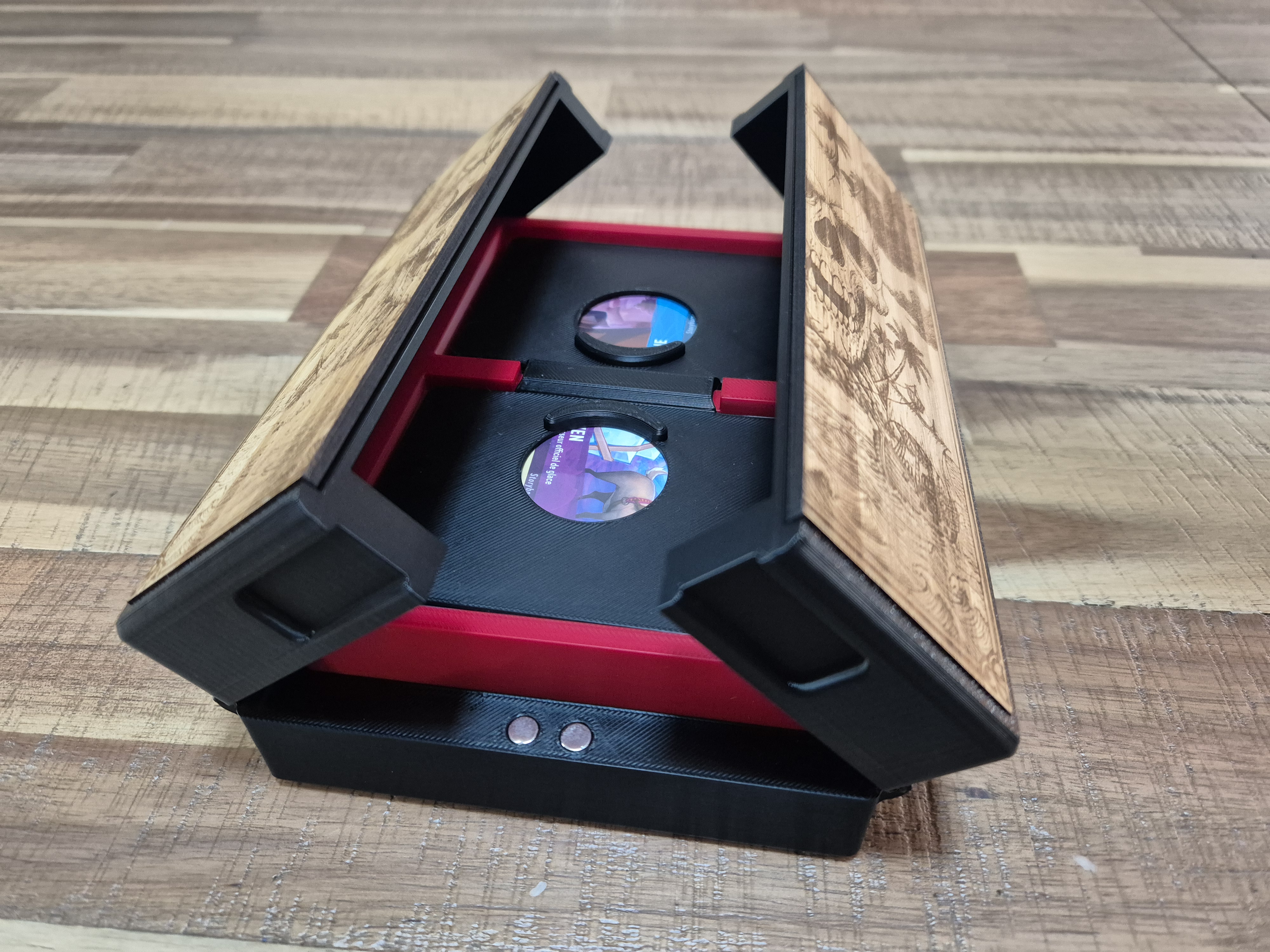
A well-designed deck box should therefore comfortably hold 70 to 80 sleeved cards, ideally with a separate compartment to keep the Don!! deck apart from the main deck. That's precisely the need some models in our PrintWonders collection answer, in particular the deck boxes with a double opening that let you store the main deck on one side and the Don!! cards on the other.
If you're looking for a deck box fully personalized in the colors of your favorite captain, our DeckSmith configurator lets you create a unique model, with the shape, color and even the patterns of your choice — ideal for turning up at a tournament with gear that looks like you.
Complementary accessories
Beyond the deck box and sleeves, a few accessories genuinely make a difference at the table:
- An official OPCG playmat or a custom mat, to mark out the play zones and protect your cards
- Dice or counters to track damage, active Don!! and continuous effects
- Specific Leader protectors, since the Leader stays visible throughout the game and wears faster than other cards
- A token box if you play summoning archetypes
Why OPCG is worth it in 2026
Three years after its global launch, One Piece Card Game has become far more than a spin-off product. The game now has its own identity, its own metagame, and a structured competitive community.
For players coming from other TCGs, the learning curve is quick: if you already know the principles of resource cost, board presence and pressure on the opponent, you'll be comfortable within a few games. For absolute beginners, the Don!! mechanic offers an excellent first contact with modern TCGs.
And for collectors, OPCG is particularly interesting territory. Manga rares (cards with artwork taken directly from the manga's pages), parallel arts and event promo cards are already the subject of heavy speculation on the secondary market.
Getting started without breaking the bank
Bandai made the smart choice of offering starter decks under €15 that are fully playable straight out of the box. Unlike other TCGs where you have to spend several hundred euros to be competitive, OPCG stays relatively affordable, especially if you stick to the Starter Deck Only format or store tournaments.
To begin, we recommend buying two different starter decks, playing ten or so games to get familiar with the mechanics, then investing progressively in a set that matches your style.
Going further
Whether you're a veteran looking for new sensations or a beginner drawn in by Luffy's world, One Piece Card Game amply deserves its place in your game library. The community is welcoming, tournaments are multiplying and the competitive scene is still young, which leaves plenty of room to make a name for yourself.
At PrintWonders, we design accessories built to last and to suit every TCG, OPCG included. Our 3D printed deck boxes, made in France, are modular enough to hold a Commander deck just as well as a One Piece deck with its Don!!. Browse our full collection and get ready to set sail on the Grand Line with the right gear.
Good games, captain!