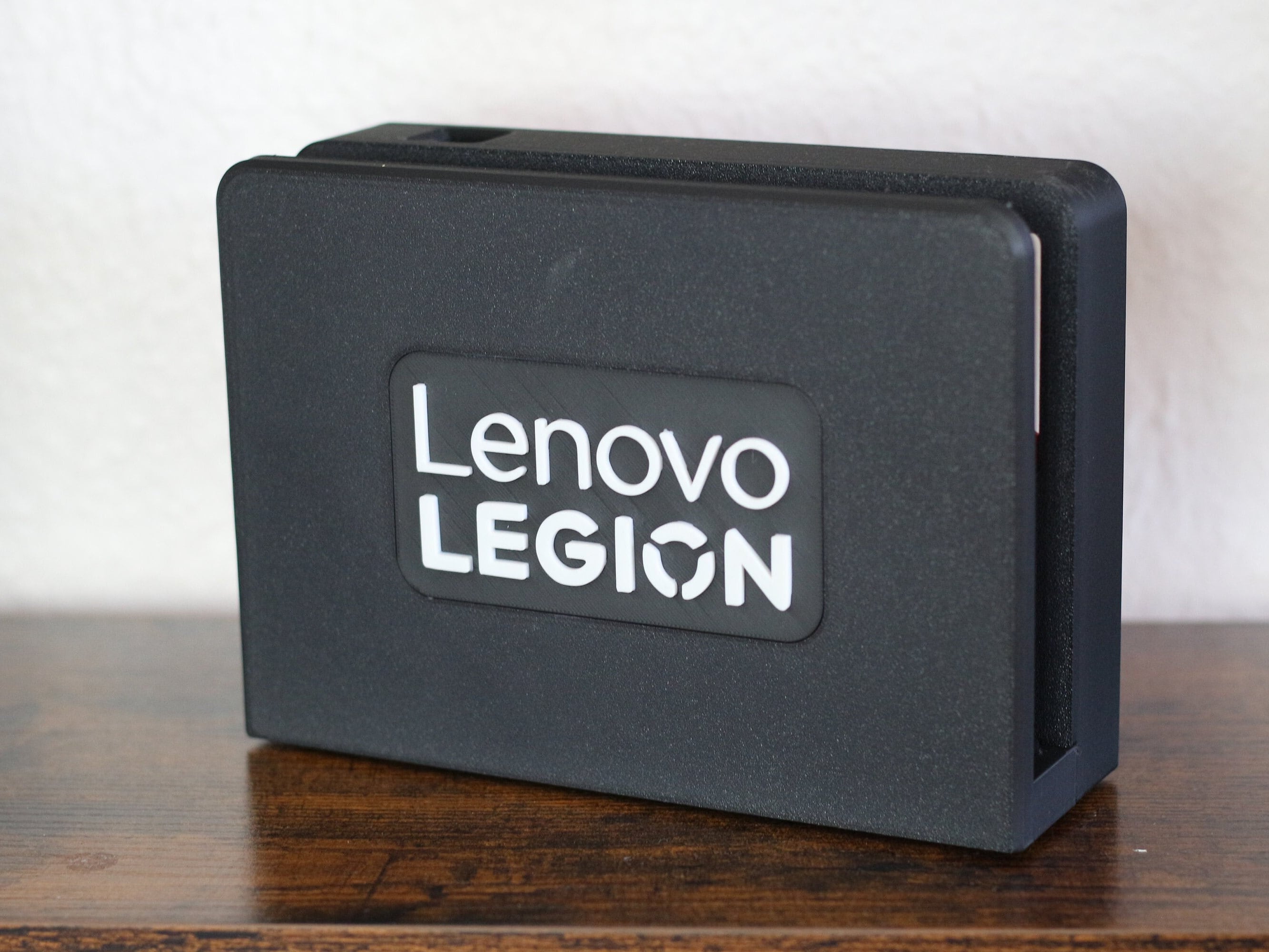
The Lenovo Legion Go brought Windows into the handheld console segment, halfway between the Steam Deck on ergonomics and a mini PC on software. Its 8.8-inch screen, its detachable controllers and the landscape format it imposes most of the time change everything as soon as you want to set it down, connect it to a TV or carry it around. Official accessories cover minimal use, and the generic third-party market largely ignores the console. On-demand 3D printing fills that gap with parts cut case by case.
This guide reviews the Legion Go and Legion Go S accessories genuinely worth printing to measure, what differs between the two models, and the material choices to make before ordering.
Why print rather than buy generic
Three differences weigh in as soon as you want a halfway serious accessory for a Legion Go.
First, the third-party market is thin. The Steam Deck has dozens of manufacturers behind it producing stands, docks and grips. The Legion Go has far fewer in its wake, especially for the more recent S version. When you're looking for a dock that fits one specific shelf or a mount that holds the console properly in landscape mode, the aisle empties fast.
Second, generic products impose their dimensions. If your TV unit is 18 cm deep, or you want to integrate the console into a vertical setup under the screen, a standard product won't adapt. A part printed on demand absorbs those constraints within millimeters.
Third, the Legion Go doesn't share exact dimensions with the Steam Deck or the ROG Ally. Buying a universal accessory often means a compromise that suits none of the three consoles. 3D printing lets you choose the right model, the right angle, the right ventilation.
Alternative dock: what really changes
This is the first request that comes up for Windows handhelds. A Legion Go plugged into a TV often replaces a mini PC or a living-room console, and the dock becomes an everyday object.
The electronics stay those of a USB-C hub
A 3D printed dock shell doesn't reinvent the connectors. It houses either a standard off-the-shelf USB-C hub, or an HDMI/USB-C module, or simply the original charger connected to a remote HDMI cable. The value isn't in the electronics, it's in the mechanics that hold the console at the desired angle, at the right height, with the ports accessible.
What 3D printing actually brings
An enclosure printed for the Legion Go lets you settle several things a generic dock can't. Locking the console at exactly the right angle for reading on the TV, an opening on the port side sized for your braided HDMI cable, side ventilation if you play for hours docked, integration under a shelf or overhanging a TV unit. The PrintWonders catalog includes dedicated docking stations for the Legion Go and Legion Go S, designed on exactly this principle: the shell houses the connectors, and the geometry is made for the specific console.
It's also a typical case for on-demand 3D printing, because you're ordering a single piece, cut for one precise case, with no production run behind it.
Stands and mounts: the segment that improves daily life
The Legion Go's detachable controllers completely change what's possible at home. Several configurations stand out.
Desk stand in landscape mode
Many players use the Legion Go with the console propped up and the controllers detached, like a small PC monitor. The built-in rear kickstand is fine for a short session but stays limited on angles. A printed stand that holds the console stable, with a lip stopping it from sliding and a width set around your keyboard, delivers comfort you notice within minutes.
Holder for detachable controllers
This is one of the Legion Go's concrete weak points: once the Joy-Pads are detached, they lie around on the desk or the sofa, resting flat on the sticks. A printed holder that takes them vertically, next to the console or clipped to the wall, keeps the controllers clean and easy to grab. The same logic applies to the Legion Go's FPS mode with its right joypad standing vertically on its base: a dedicated desk holder transforms the experience.
Wall mounts and fixings
Acoustic slat walls, now very common in gaming setups, take 3D printed console mounts very well. A mount that clips between two slats, holds the Legion Go vertically with no contact on the front of the screen, and lets a charging cable through: that's exactly the kind of combination missing from shops. The same logic applies as for acoustic slat wall accessories: no screws, repositionable.
Legion Go vs Legion Go S: what changes for accessories
The two models share a philosophy but not their dimensions, and many accessories aren't interchangeable.
Legion Go (original model)
A console designed for very modular use, detachable controllers, original dock sold separately. The most useful accessories: a stable desk stand, a slim alternative dock, vertical storage for the Joy-Pads, a landscape-oriented wall mount. The rear kickstand remains a weak point that users often prefer to work around with an external stand.
Legion Go S
A more compact variant, controllers built into the chassis, revised dimensions. Legion Go accessories don't systematically mount on the S, and vice versa. Specifying the exact model when ordering avoids 90% of compatibility problems. On the dock side, the Legion Go S calls for its own enclosure, shorter in width. On grips, the lack of modularity changes things: you're not looking for a holder for a detached pad but rather a shell or grip that adds to the console.
A special case: multi-handheld setups
If you own several handhelds (Steam Deck, Legion Go, ROG Ally), a shared custom stand becomes relevant. A single stand with several cradles, each dimensioned for a specific console, takes up less space than three generic stands piled together. That's typically the playing field of custom printing: you design once, and print the piece you need.
The materials that really work for the Legion Go
Material choice depends on the type of accessory and the area involved.
| Accessory | Recommended material | Why |
|---|---|---|
| Desk stand, wall mount | Standard PLA | Enough indoors, clean finish, wide color choice |
| Dock enclosure (electronics side) | PETG | Better heat resistance near the USB-C hub or HDMI module |
| Added shell or grip | PETG | Tougher in a drop or under repeated handling |
| Transport cradle | PETG | Impact resistance and slight torsion |
| Wall-mounted controller holder | Standard PLA | No mechanical or thermal stress |
PLA suits most indoor accessories. Its heat sensitivity, around 55-60 °C, only causes problems on parts directly exposed to a hot electronic module or to prolonged direct sunlight. For those cases, PETG takes over without costing much more. On finish, a wood PLA gives a distinctive look on a stand or a wall mount if you want to escape uniform all-plastic.
Frequent pitfalls to avoid before ordering
Three mistakes come up regularly and are best anticipated before the quote.
- Not confirming the exact model. Legion Go first version, Legion Go S: these consoles have different dimensions and ergonomics. A part that fits perfectly on one sometimes won't mount at all on the other. Always specify it in the request.
- Underestimating the heat near the dock. A PLA enclosure placed directly against a USB-C hub under load, beneath a fast charger, can deform after several hours of continuous play. PETG resists better and is the right choice as soon as you're near a heat source.
- Wanting a "universal" STL. The best 3D printed Legion Go accessories are the ones cut for one precise case. Asking for a part that would also work for the Steam Deck or the ROG Ally often gives a result that's mediocre everywhere. It's better to describe your exact use (where the console sits, how it's plugged in, what's next to it) and let the 3D file adapt to it.
From file to object: how it works in practice
Three cases come up when ordering.
You already have your STL
You found a model you like on a sharing platform or modeled it yourself: send the file, choose the material and color, approve the quote. Count on a few days in production depending on the size and complexity of the part.
You want an existing part, adapted
The most common case. You'd like a Legion Go dock holding the console plus an external USB-C SSD, 16 cm wide so it fits your cabinet. That's the ideal ground for on-demand printing: we start from a model or a sketch, adapt the dimensions, and print it as a single piece.
You're starting from nothing
An accessory idea that doesn't yet exist in any third-party catalog. The more precise the description (dimensions, constraints, expected use, desired finish), the more reliable the quote and the lead time. A few photos or a paper sketch are often enough to start. For this kind of request, the most effective route is to describe the project to us with the dimensions and the use: we'll come back with a realistic proposal.
To place an order
The PrintWonders catalog offers several ready-to-ship gaming accessories, including docking stations dedicated to the Lenovo Legion Go and Legion Go S. For a custom request (exact model, dimensions to respect, particular finish), start from the on-demand 3D printing page. And if you're still unsure about the right angle, the right material or compatibility between the two versions of the console, the quickest route is often to ask directly with a photo of the space involved: the answer generally arrives the same day.